Chess Rapid Game Improvement Tips That Actually Work
 Swayven
Rapid chess improvement is defined as the measurable gain in move quality, time efficiency, and tactical accuracy that players achieve through deliberate, structured practice under faster time controls. The most effective chess rapid game improvement tips share one trait: they target the specific pressures of rapid formats, where a 10+0 or 15+10 game demands both calculation depth and clock discipline. Players who plateau in rapid chess almost always share the same problem. They practice randomly, skip endgame study, and never buinld a consistent pre-move routine. This guide fixes all three.
How to manage your time efficiently during rapid chess games
Time management is the single biggest differentiator between players of similar tactical strength in rapid chess. A 15+10 game yields roughly 21 minutes of total thinking time across 40 moves. That works out to about 30 seconds per move on average, which sounds generous until a complex middlegame position burns five minutes in one sitting.
The solution is to categorize your moves before you make them. Routine moves, such as recaptures and forced responses, deserve 5–15 seconds. Positional decisions, like choosing between two reasonable plans, warrant 30–60 seconds. Genuinely critical moments, where the game turns on one calculation, justify up to 2–3 minutes. Spending more than that on any single move in a rapid game almost always creates time trouble later.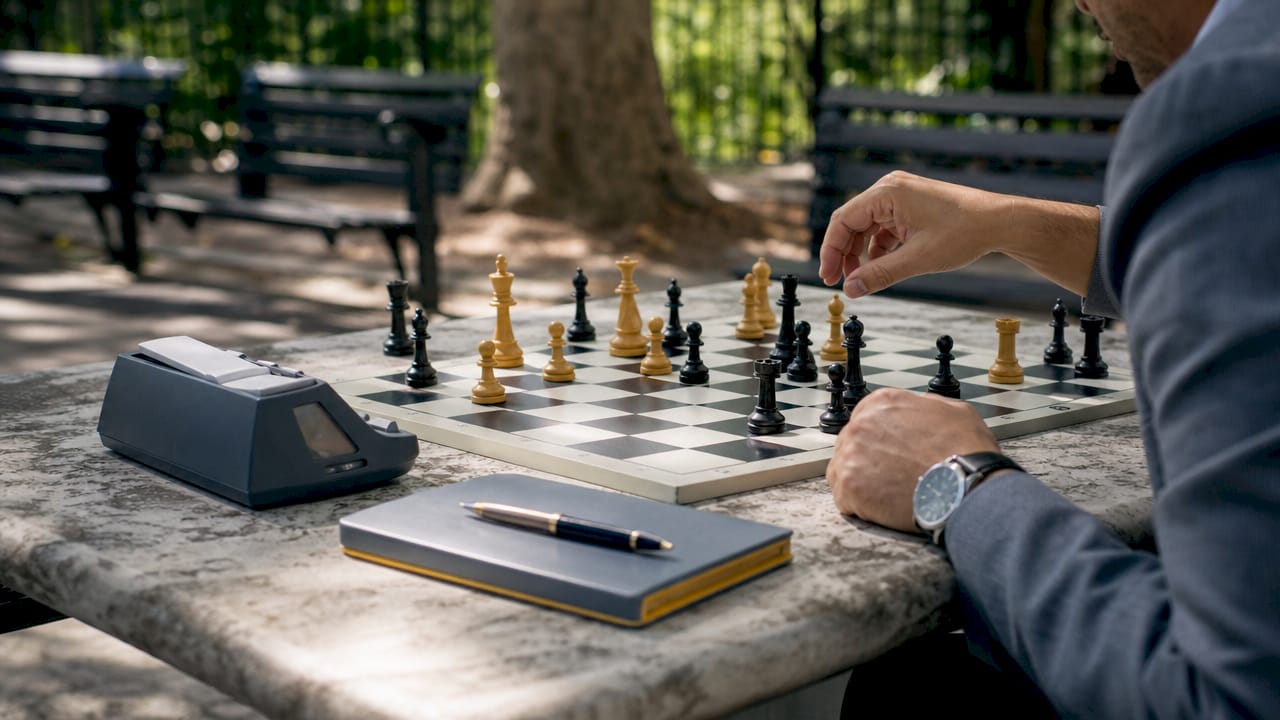
| Move type | Suggested time | Examples |
|---|---|---|
| Forced/recapture | 5–15 seconds | Taking back a captured piece |
| Routine development | 15–30 seconds | Castling, standard piece placement |
| Positional choice | 30–60 seconds | Choosing between two plans |
| Critical calculation | 90–180 seconds | Tactical sequences, king attacks |
Use your increment wisely. In a 15+10 game, the 10-second increment per move means you can recover time on simple moves. Bank those seconds deliberately.
Pro Tip: When your clock drops below two minutes, stop calculating long variations. Play the move that makes the most structural sense and trust your preparation. Panic calculations in time trouble produce more blunders than any other single cause.
What is the two-step safety check and why it prevents blunders in rapid chess
The two-step safety check is a pre-move mental habit that takes 2–5 seconds and eliminates most free material losses in rapid play. It consists of two questions asked in sequence before every move.
First: Is my piece safe on the new square? Check whether any opponent piece attacks the destination. Second: Does this move leave another piece undefended? Scan your entire board position for pieces that lose protection when you move.
That second question catches the majority of blunders. Players fixate on the piece they are moving and forget that shifting it removes a defender elsewhere. Verbalizing candidate moves and threats mentally before acting is one of the most reliable ways to break tunnel vision.
Common mistakes the two-step check prevents:
Moving an attacking piece and leaving your queen unprotected
Advancing a pawn and opening a diagonal to your king
Capturing a piece and missing that your rook is now hanging
Playing a “natural” developing move that walks into a fork
Pro Tip: Practice the two-step check in slower games first, where time pressure is low. Once it becomes automatic at longer controls, it carries over to rapid without costing extra clock time.
How to structure your chess study for rapid game improvement
Active study beats passive watching every time. Watching grandmaster games without solving positions yourself builds pattern recognition weakly. Solving puzzles without a timer, analyzing your own games honestly, and drilling specific tactical motifs builds it deeply.
The most effective structure follows a three-pillar cycle: play serious games, review them honestly, then train the specific patterns your review exposed. Each pillar feeds the next. A game reveals a weakness. The review identifies it precisely. The training session targets it directly.
“Effective review looks beyond engine blunders to the moments where your decision-making confidence dropped. Those are the positions that actually cost you games.”
Trying to fix multiple weaknesses at once is ineffective. Isolating one pattern for 2–4 weeks installs the habit properly before you move on. A player who spends three weeks on knight forks, then three weeks on rook endgames, improves faster than one who works on everything loosely.
Allocate your study time with this priority order:
Tactics puzzles (40% of study time): Focus on the patterns your game reviews expose most often.
Practical endgames (30%): King and pawn endings, basic rook endgames, and checkmate patterns.
Game analysis (20%): Your own games first, engine second. Find the moments your confidence dropped.
Opening review (10%): Understand the plans, not the move sequences.
One deeply considered rapid game teaches more than five rushed blitz games. Rapid chess gives you enough time to calculate and evaluate, which means the decisions you make in those games are worth studying carefully.
What opening and endgame principles accelerate rapid chess improvement
Opening theory is the most overstudied area for players below the master level. Rapid game improvement centers on piece development, time discipline, and king safety, not memorized move sequences. A player who understands why the Italian Game controls the center will outperform a player who memorized 15 moves of the Najdorf but cannot explain the plans.
Build a simple, solid opening repertoire around three principles: control the center with pawns or pieces, develop knights before bishops, and castle before launching attacks. These principles hold across almost every opening system and require no memorization beyond move 10.
Key endgames every rapid player should master:
King and pawn opposition: The foundation of all pawn endgames. Knowing when you hold the opposition wins or saves games that look drawn.
Philidor position: The defensive technique in rook endgames. Knowing this saves half-points constantly.
Lucena position: The winning technique when you have rook and extra pawn. Converts winning positions that players otherwise draw.
Basic checkmate patterns: Queen and king, rook and king, two bishops. These end games quickly and save clock time.
Endgame mastery reduces time usage and improves winning chances in time scrambles. A player who knows the Philidor position reaches it in 10 seconds. A player who does not know it burns two minutes calculating and often still draws incorrectly.
| Opening type | Core benefit | What to learn |
|---|---|---|
| 1.e4 openings (Italian, Ruy Lopez) | Central control, clear plans | Piece activity and king safety |
| 1.d4 openings (London, Queen’s Gambit) | Structural solidity | Pawn structure and piece coordination |
| Sicilian Defense (as Black) | Counterattacking chances | Plan-based thinking, not move memorization |
| French/Caro-Kann (as Black) | Solid, low-theory defense | Pawn breaks and piece activity |
How to handle psychological challenges in rapid chess
Calm decision-making under clock pressure separates rapid winners from their opponents more reliably than any single tactical skill. The most common psychological error in rapid chess is rushing a move the moment you feel time anxiety. That rush produces the exact blunder the two-step check was designed to prevent.
Tunnel vision is the second major problem. Players lock onto one plan and stop asking whether the opponent has a threat. The fix is simple: before every move, ask “What is my opponent threatening?” first. Answer that question, then decide your move.
Practical habits that build psychological resilience in rapid chess:
Play occasional classical or longer rapid games to practice calm calculation without clock pressure.
After a bad move, reset mentally before the next one. One blunder does not lose a game. Two consecutive blunders often do.
Trust your opening preparation through the first 10–12 moves. Deviating from your own repertoire because you “feel” something is wrong wastes time and confidence.
Accept that you will lose games. Consistent practice and honest review build improvement faster than avoiding difficult opponents.
Pro Tip: Play one slow game (30 minutes or more per side) for every five rapid games you play. Slow games rebuild the calculation habits that rapid play gradually erodes. Players who only play rapid often develop shallow thinking patterns without realizing it.
Key takeaways
Rapid chess improvement requires disciplined time allocation, a consistent pre-move safety check, active study cycles, and targeted endgame knowledge applied together as a system.
| Point | Details |
|---|---|
| Time allocation by move type | Spend 5–15 seconds on forced moves and up to 3 minutes only on critical calculations. |
| Two-step safety check | Ask two questions before every move to eliminate free material losses in 2–5 seconds. |
| Three-pillar study cycle | Play serious games, review honestly, then train the specific patterns your review exposed. |
| Endgame knowledge saves time | Knowing the Philidor and Lucena positions converts or saves games without burning clock time. |
| Narrow training cycles work | Focus on one pattern for 2–4 weeks before moving on to install habits properly. |
What I’ve learned from years of watching rapid chess improvement stall
The most common reason players stop improving in rapid chess is not lack of talent. It is scattered practice. I have watched players spend months on opening theory, reach move 12 with a perfect position, and then blunder a piece because they never built a pre-move routine. The opening study was wasted.
The shift that actually moves the needle is committing to the three-pillar cycle and refusing to skip the review step. Most players play, lose, and immediately start the next game. That habit feels productive. It is not. The game you just finished contains the exact information you need to improve, and you are walking away from it.
I also think the psychological side of rapid chess gets underestimated. Knowing the Lucena position is a skill. Staying calm when you are down two minutes on the clock and need to find the right plan is a different kind of skill entirely. The players who build both tend to improve faster than anyone expects.
Rookify helped me see my own patterns more clearly. Syncing games and reviewing them through a structured analysis tool showed me that I was losing most of my rapid games in the same phase, with the same type of mistake. That kind of clarity is hard to get from memory alone.
How Rookify supports your rapid chess training
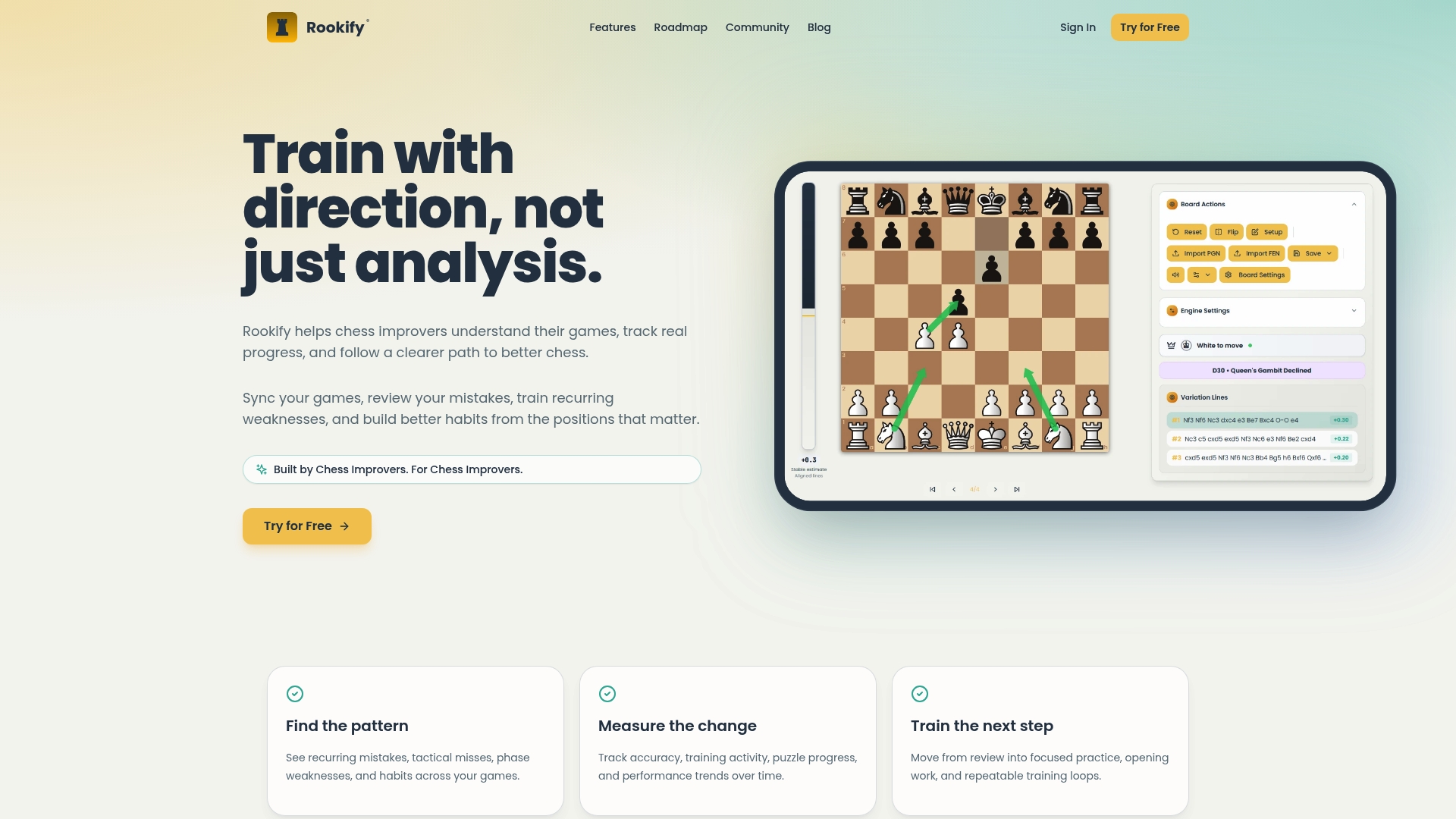
Rookify is built for players who want structured improvement, not just more games. The platform syncs your games from Chess.com and Lichess, identifies your recurring mistakes, and turns those findings into targeted practice sessions. Instead of guessing what to work on, you see exactly where your rapid games break down.
Rookify’s daily puzzle review and practice mode connect directly to the three-pillar cycle described in this article. You play, Rookify analyzes, and the training sessions target the patterns your games expose. The result is a study routine that tightens with every game you play. Players at every level use it to move from random practice to focused, measurable progress.
FAQ
What is rapid chess and how does it differ from blitz?
Rapid chess uses time controls between 10 and 60 minutes per player, with common formats like 10+0 and 15+10. Blitz uses shorter controls of 3–5 minutes, which leaves far less time for calculation and strategic thinking.
How long should I spend on a single move in rapid chess?
Spend 5–15 seconds on forced or routine moves and up to 2–3 minutes on genuinely critical positions. Spending more than 3 minutes on any single move in a rapid game almost always creates time trouble later.
What is the fastest way to reduce blunders in rapid chess?
Apply the two-step safety check before every move: verify the moved piece is safe on its new square, then check whether the move leaves any other piece undefended. This habit takes 2–5 seconds and eliminates most free material losses.
Should I study openings or endgames first?
Study endgames first. Basic endgame knowledge like king-pawn opposition and rook techniques pays larger dividends in rapid chess than opening memorization, especially under time pressure.
How many games should I analyze per week to improve?
Analyze every serious rapid game you play. Reviewing your own games to find moments where your decision confidence dropped produces more improvement than any fixed number of games reviewed superficially.